 Magrittrdigester report
Your digester’s metabolic capacity, read from its DNA
Send one tube of digestate. You learn which microorganisms are there, which routes to methane they carry, and how much reserve your reactor has before you change the feed.
Every plant is different. Write to me about yours and I will tell you what a sample can answer and what it cannot.
Example reports
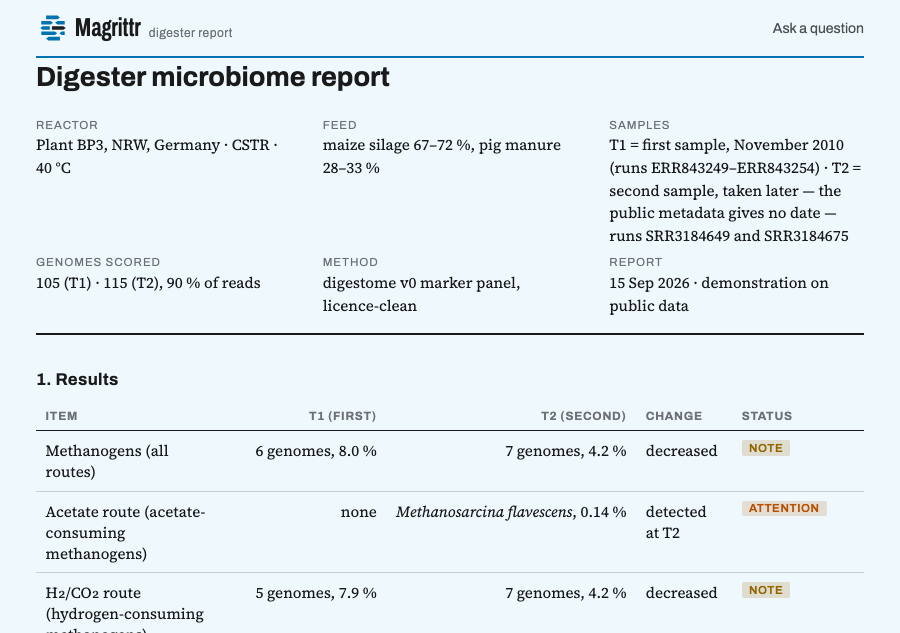
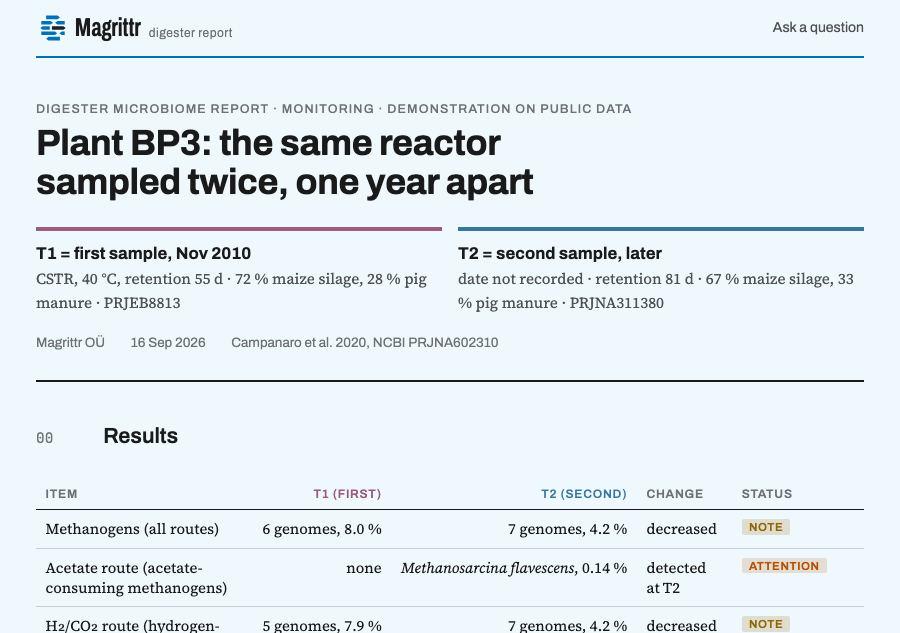
The results table of a real report: plant BP3, Germany, the same reactor sampled twice, public data.
| Item | T1 (first) | T2 (second) | Change | Status |
|---|---|---|---|---|
| Methanogens (all routes) | 6 genomes, 8.0 % | 7 genomes, 4.2 % | decreased | note |
| Acetate route (acetate-consuming methanogens) | none | Methanosarcina flavescens, 0.14 % | detected at T2 | attention |
| H₂/CO₂ route (hydrogen-consuming methanogens) | 5 genomes, 7.9 % | 7 genomes, 4.2 % | decreased | note |
| Methyl route (methyl-consuming methanogens) | 1 genome, 0.18 % | 1 genome, 0.14 % | no change | ok |
| Cellulose breakdown (genomes carrying the enzymes) | 22 genomes, 14.1 % | 18 genomes, 8.2 % | decreased | note |
| Protein breakdown (genomes carrying the enzymes) | 71 genomes, 41.4 % | 71 genomes, 40.4 % | no change | ok |
| Propionate pathway (genomes carrying it) | 19 genomes, 11.0 % | 14 genomes, 12.0 % | no change | ok |
| Ammonia release from ethanolamine (genomes carrying the pathway) | 2 genomes, 0.84 % | 1 genome, 0.12 % | decreased | ok |
| Butyrate oxidation | — | — | — | not assessed |
| Ethanol fermentation | — | — | — | not assessed |
| Lactate fermentation | — | — | — | not assessed |
| Direct interspecies electron transfer | — | — | — | not assessed |
| Energy conservation | — | — | — | not assessed |
Each value gives the number of genomes and their share of the mapped reads. ok = nothing unusual. note = thin, present or changed, not a fault by itself: the report names the measurement to check. attention = a route is missing or very weak. not assessed = no reliable marker, not zero.
The two samples come from two different public studies, so part of any change can come from a different DNA extraction and sequencing run. A client series uses one protocol for all samples. This table maps the reactor against its own published genomes. The method paper maps the same second sample against the Genome Taxonomy Database, so it names six methanogens, not seven. Read the one-page summary or the full report.
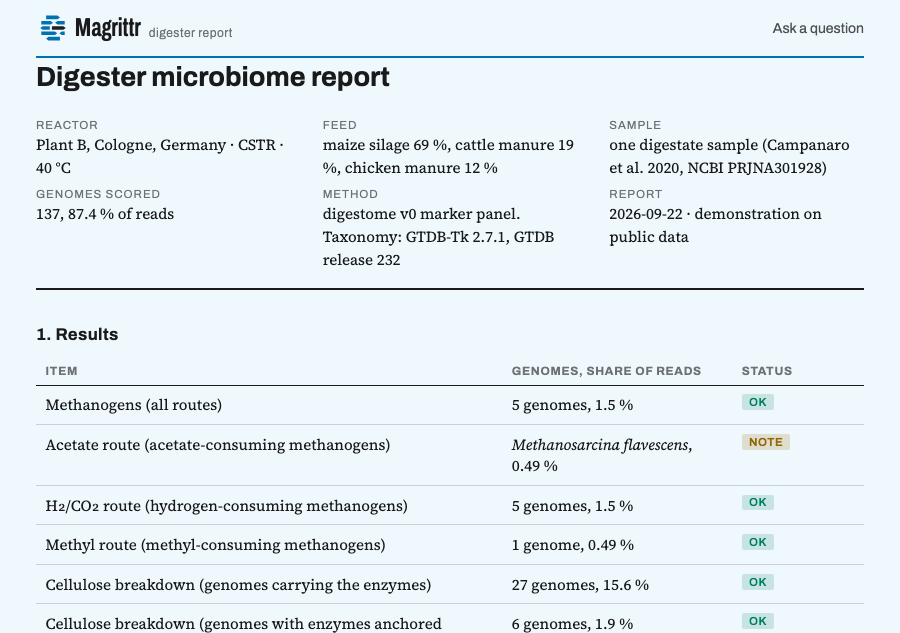
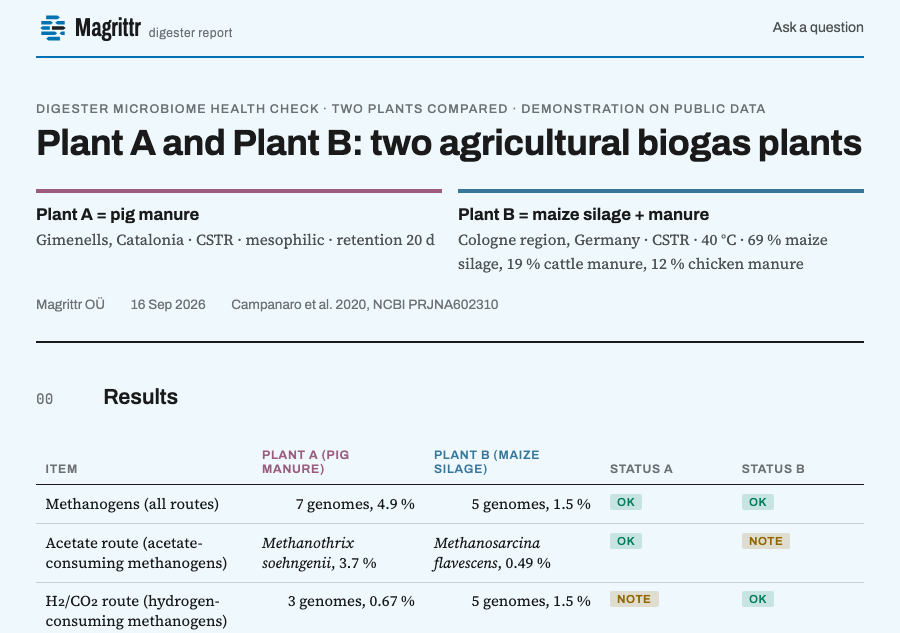
The four below are finished reports, shown as examples. They are not packages to choose from: every order includes the one-page summary and the full report.
- What you send
- 1 ml digestate, in the tube I post you
- What you get
- One-page summary, full report, four result tables, methods with tool versions
- How long
- 2–4 weeks from the sequencing data
- What it costs
- €305 per sample, €250 one-off setup, sequencing at the lab’s price plus 15 % (about €305, extraction, sample tube and courier included)
You ask yourself
- Can I raise the load, or is something in the chain already at its limit?
- If the acetate route rests on one organism, what happens when ammonia rises?
- Is the hydrogen route thin enough that a trace-element check is worth the money?
- After a feed change, did the community actually follow?
These are questions about organisms. FOS/TAC and gas yield tell you the outcome. They cannot tell you who produced it, or what is available in reserve if the load changes.
How it works
- Ask. An e-mail or a short call. You get a fixed written quote. Your written confirmation is the order, and nothing is committed before it.
- Sample. I post a kit: tube, preservation buffer, packaging and a prepaid return label. 1 ml of digestate into the tube, and back with the label in the kit.
- Sequencing. Ordered for you from a commercial sequencing lab, at its price plus 15 % for handling, or send data from your own provider. The quote names the lab and the country it works in.
- Report. I assemble the genomes of the microorganisms common enough in your sample, and find the rarer ones, down to about 0.1 %, by matching your reads against public reference genomes. Then I score what each of them can do and write the report myself. One-page summary, full report, the four result tables, methods with every tool version. 2–4 weeks.
- Call. A short call to go through it, if you want one. One revision round is included.
There is no black box: the method is public, described in plain words and in a scientific paper.
What a real order costs
| One reactor, first sample: analysis €305 + one-off setup €250 | €555 |
| Sequencing for that sample, with DNA extraction, sample tube and courier: the lab’s price plus 15 % for handling | about €305 |
| Total, first sample | about €860 |
|---|---|
| Each further sample (no second setup fee) | €305 + about €305 |
| Four samples a year, each compared with the earlier ones | €1,220 / yr + sequencing |
Magrittr OÜ is not VAT-registered, so these are final prices, not net ones. Sequencing is ordered for you and invoiced at the lab’s price plus 15 % for handling. Send data from your own provider instead, and that line disappears. Prices last updated: 16 October 2026.
The good-day sample
Take a sample while the plant is running well, and keep it. Not when something goes wrong: by then there is nothing to compare against.
- On an ordinary good week, 1 ml of digestate from your usual sampling point.
- Into the preservation tube I post you. Room temperature is fine, the freezer is better.
- Write the date on the label and fill in the one-page sheet that comes with the tube: feed mix, temperature, anything unusual. That is the whole protocol.
- Keep it. If the plant behaves, you have lost a tube. If it does not, you have a before.
The tube is free. Ask and I post you one. You pay for sequencing and analysis only if you decide to have the sample read, and you are not obliged to send it back.
What is controlled, and what is not
| Controlled | Versioned pipeline and panel, both public. The reference database release number in every report. A stated detection limit of 0.1 % of mapped reads. Result tables hashed in the report. A module without a reliable marker is reported as not assessed, never as zero. |
|---|---|
| Not claimed | No laboratory accreditation and no ring-test participation. Sequencing is subcontracted. The analysis is one person’s work, checked by public benchmarks rather than by a certificate. If that matters for your purpose, say so, and I will tell you whether this is the wrong tool. |
Who reads your sample

Taavi Päll, PhD, computational biologist in Tartu. The person who built the analysis runs your data and writes your findings, and your questions come straight to me. Nothing is lost in the handover between a pipeline engineer, an analyst and whoever writes the text.
Pipelines are open source: aftekas (reads to genomes) and digestome (the digester panel). Archived method · preprint
Questions
How often should I sample?
Every three months on a stable plant. Monthly around a feed change, or after an upset. One sample is a snapshot, two are a comparison.
Where is my data?
On the University of Tartu compute cluster, under a service contract with a confidentiality annex. Sequencing data and results are deleted after delivery on request.
Can you compare my plant with others?
Only with your written consent, and only against plants whose owners gave theirs. The examples on this site are public data.
I have 40 samples. Can one person handle that?
Partly, and it is worth saying which part. The pipeline runs on a university HPC cluster and scales with the samples. Forty assemblies cost more compute, not more weeks. What does not scale is the reading: the findings, the comment and the suggestions are written per sample, by me. In practice that means batches. Up to about ten samples run on the standard turnaround. Larger sets get a date agreed before you order. If you need a hundred samples next month on a guaranteed date, I am the wrong supplier. I will say so rather than take the order.
What if the report says nothing useful?
It sometimes will: a community can be unremarkable, which is itself an answer. The report says what it found and what it could not assess, and that is what you paid for.
Other sample types
| Level | What you get | Per sample | Turnaround |
|---|---|---|---|
| Community snapshot | 16S/ITS taxonomy and abundances, diversity, report and tables | €120–200 | 1–2 weeks |
| Shotgun profiling | Species-level profile, functional summary, differences between groups | €280–450 | 2–4 weeks |
| Genome-resolved | Genomes assembled from the reads, licence-clean functional profiling | €500+ | 4–6 weeks |
Food and fermentation, probiotics, aquaculture, environmental and water samples, labs without a bioinformatician. Setup fee €150–500 per project, discounts from 10 samples.
This table is for other kinds of samples. The digester report above is a fixed package with its own price and turnaround: €305 per sample, 2–4 weeks.
Thinking about a first sample, or not sure whether a sample can answer your question?
Ask a question